

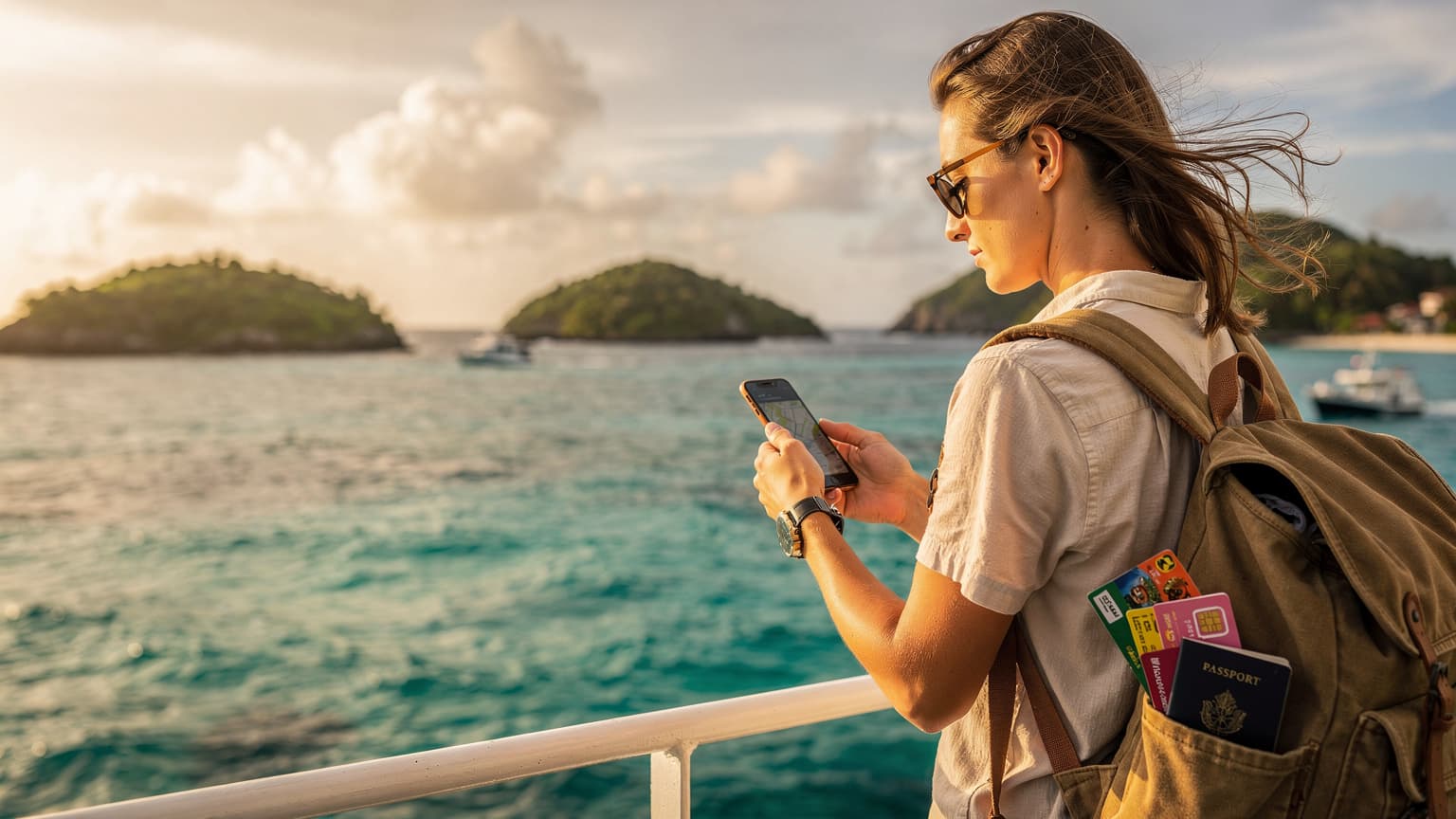
The Caribbean Connectivity Conundrum: Why Island Hopping is Different
I remember my first time trying to cobble together connectivity across the Lesser Antilles. One day I was in Saint George's, Grenada, scrambling to find a Digicel shop before they closed at 4 PM (and they usually close earlier on Fridays, mind you). The next, I was stepping off a LIAT flight in Bridgetown, Barbados, and starting the whole process over again for a Flow SIM. It was a tedious dance, a literal island-by-island data quest that ate into precious beach time and budget. The Caribbean, while a paradise for divers and sun-seekers, presents a unique challenge for staying online.
Unlike continental travel, where a regional SIM often covers vast stretches of land (think the European Union or North America), the Caribbean is a patchwork of independent nations and territories, each with its own local telecoms, regulations, and pricing structures. What works beautifully in San Juan, Puerto Rico, won't necessarily roam affordably in Basseterre, St. Kitts. This fragmentation is precisely where the modern eSIM steps in as a true game-changer for the savvy traveler.
The Cost of Disconnection and Reconnection
Beyond the sheer inconvenience, the financial drain of continually buying new local SIMs adds up. Each time you land, you're looking at a new purchase, often in local currency, navigating language barriers, and figuring out data packages. On some smaller islands, like Bequia in St. Vincent and the Grenadines, finding a dedicated phone shop might mean a long walk or an expensive taxi ride from Port Elizabeth to a less touristy part of the island, just to top up your data. My personal record for wasted time? Three hours in Santo Domingo's Zona Colonial trying to activate a new SIM, only to discover I needed my passport, which was back at the hotel in Gazcue.
The Mental Load of Managing Multiple Local SIMs
It's not just the money or the time; it's the mental overhead. Remembering which tiny plastic card belongs to which island, keeping track of different phone numbers, and trying to understand varying expiry dates becomes a constant low-level stressor. Imagine trying to book a last-minute catamaran tour from Rodney Bay in St. Lucia, or coordinate a taxi from Sangster International Airport in Montego Bay, Jamaica, only to find your data plan expired an hour ago because you miscalculated the time zones. (Yes, I've done it, more than once.) This is precisely the kind of friction a multi-country eSIM aims to eliminate, allowing you to focus on the swaying palms and the sound of the waves, not your phone's network status.
eSIMs vs. Traditional SIMs: The Island Hopper's Advantage
For years, the standard advice for international travel was to grab a local SIM card. It made sense: better rates, local number access, generally reliable service. But that advice was largely crafted for single-country stays. When you're bouncing from Antigua to Dominica to Martinique within a week, the traditional SIM model quickly unravels. This is where eSIM technology truly shines, particularly for the Caribbean adventurer.
No More Physical Swapping: A Digital Solution
The most obvious benefit of an eSIM is its digital nature. There's no physical card to insert, lose, or swap. Your phone, if it's eSIM compatible (most newer iPhones, Android flagships, and even some smartwatches are), has the eSIM functionality built right in. This means you can purchase, activate, and manage your data plan entirely from your device, often before you even leave home. I've activated an eSIM while waiting for my flight to clear customs at Piarco International Airport in Trinidad, and it felt like a superpower compared to my old routine.
Consider the scenario: you've just disembarked a small regional plane at Melville Hall Airport in Dominica, a charming but often rain-swept landing strip. Instead of hunting for a SIM vendor, you're already connected, able to call your rental car company or look up directions to your guesthouse in Roseau. It's a small detail that makes a huge difference in the flow of your arrival.
Multi-Country Coverage Simplified
Many Caribbean eSIM plans are designed for regional coverage, meaning one plan can work across multiple islands. This is the holy grail for island hoppers. Instead of navigating separate providers like BTC in the Bahamas, Digicel in Jamaica, and Lime (now Flow) in Grenada, you get a single, overarching data allowance. This not only simplifies your connectivity but often provides better value, as these regional plans are tailored for travelers.
| Feature | Traditional SIM Card | eSIM (Multi-Country Plan) |
|---|---|---|
| Physicality | Plastic card, easily lost/damaged | Digital profile, embedded in device |
| Activation | Manual insertion, often requires in-store purchase & registration | Downloadable profile, activation via QR code/app, often before travel |
| Multi-Country Use | Requires new SIM for each country or expensive roaming | Single plan covers multiple countries, seamless transitions |
| Convenience | Time-consuming, requires finding local vendors | Instant connectivity, managed digitally |
| Dual SIM Functionality | Often occupies one slot, leaving little room for home SIM | Allows home number to remain active for calls/texts, local data via eSIM |
Keeping Your Home Number Active
One of the less-talked-about but incredibly valuable benefits of eSIM is the ability to maintain your primary phone number. With a physical SIM swap, you often lose access to your home number, which can be problematic for two-factor authentication, receiving calls from family, or accessing banking apps. With eSIM, your home SIM can remain active for calls and texts (though be mindful of roaming charges for these), while your eSIM handles all your data needs. This dual-SIM functionality is a lifesaesaver when you need to access that verification code from your bank while browsing duty-free at Hewanorra International Airport in St. Lucia.
Choosing the Right eSIM Plan for Your Caribbean Adventure
Not all eSIMs are created equal, especially when it comes to the Caribbean's diverse geography. Picking the right plan involves a bit of foresight and understanding your own travel habits. The key is to balance coverage, data allowance, and duration with your itinerary.
Regional vs. Single-Country eSIMs
For island hopping, a regional Caribbean eSIM plan is almost always the superior choice. These plans typically cover a wide array of islands, from the bustling streets of Havana, Cuba, to the tranquil shores of Grand Turk, Turks and Caicos. While a single-country eSIM might offer slightly better rates if you're staying put for an extended period, the moment you cross a watery border, you'll be back to square one. Always check the list of included countries before you commit. Some regional plans are truly extensive, covering dozens of destinations, while others might focus on a specific sub-region, like the Eastern Caribbean.
Data Allowance: How Much Do You Really Need?
This is where an honest assessment of your digital habits comes in. Are you just checking emails and WhatsApp, or do you plan to stream Netflix on a rainy evening in your guesthouse in Soufrière, St. Lucia? Navigating Google Maps, posting photos to Instagram, and light browsing usually don't consume vast amounts of data. However, video calls home, heavy social media use, or tethering your laptop for work (a common digital nomad habit) can quickly deplete even a generous plan. I usually opt for a plan with at least 10GB for a two-week trip if I expect to be fairly reliant on data, especially if I'm uploading photos daily.
| Data Usage Activity | Estimated Data Consumption (per hour) | Recommendation for Island Hopping |
|---|---|---|
| Basic Web Browsing/Email | 50-100 MB | Small daily allowance (1-2GB for a week) |
| Social Media (browsing/light posting) | 100-200 MB | Medium allowance (3-5GB for a week) |
| Google Maps/Navigation | 20-50 MB | Minimal, but crucial. Factor into daily use. |
| Streaming Music (Spotify/Apple Music) | 150 MB | Consider offline downloads. |
| Video Calls (WhatsApp/Facetime) | 300-500 MB | Heavy usage, find Wi-Fi where possible. |
| HD Video Streaming (Netflix/YouTube) | 1-3 GB | Use only on reliable Wi-Fi. |
Duration: Matching Your Trip Length
eSIM plans come in various durations, typically ranging from 7 days to 30 days, or even longer. For a typical Caribbean island-hopping trip, a 15-day or 30-day regional plan often makes the most sense. This provides flexibility if your travel plans shift slightly (which, let's be honest, they often do in the Caribbean). Avoid buying multiple shorter plans if a single longer one covers your entire itinerary and the same countries. It's an unnecessary complication.
Provider Reputation and Customer Support
While the allure of a cheap plan is strong, consider the reputation of the eSIM provider. Good customer support can be invaluable if you encounter an issue while you're halfway between St. Martin and Anguilla. Look for providers with clear instructions, responsive helpdesks, and positive traveler reviews. A few extra dollars for peace of mind is always a worthwhile investment, especially when connectivity is crucial for things like coordinating ferry schedules or checking hotel bookings.
Setting Up Your eSIM for Caribbean Travel: A Step-by-Step Guide
One of the biggest advantages of eSIMs is their straightforward activation process. You don't need a tiny pin to open a SIM tray or a trip to a local store. It's all done digitally. Here's how I typically get myself connected for a multi-island adventure:
- Purchase Your Caribbean Regional eSIM Plan: Head to the provider's website, for instance, and select a regional plan that covers all the islands on your itinerary. Double-check the included countries, data allowance, and validity period. You'll usually receive an email with a QR code and manual installation details.
- Install the eSIM Profile (Before You Depart): I always recommend installing the eSIM profile while you still have a stable Wi-Fi connection, ideally before you even leave home. On an iPhone, go to Settings > Cellular (or Mobile Data) > Add eSIM. Choose 'Use QR Code' and scan the code from your email or another device. Follow the prompts to label your new plan (e.g., 'Caribbean Travel').
- Configure Data Roaming Settings: Once installed, you'll want to ensure your phone uses the eSIM for data. Go back to Settings > Cellular (or Mobile Data). Under 'Cellular Data' or 'Mobile Data', select your new eSIM plan. Crucially, make sure 'Data Roaming' is turned ON for your eSIM. For your primary SIM, you can leave it active for calls/texts but turn off its data roaming to avoid unexpected charges.
- Activate Upon Arrival: While the eSIM profile is installed, it often won't 'activate' or start its validity period until it connects to a supported network in one of the covered countries. Once you land, say at Grantley Adams International Airport in Barbados, your phone should automatically connect to a local partner network (like Flow or Digicel). You'll then be online and ready to go.
- Monitor Data Usage: Keep an eye on your data consumption through your phone's settings or the eSIM provider's app, if available. This helps prevent unexpected depletion, especially if you're bouncing between islands with varying network strengths and might be tempted to stream more.
Real-World Scenarios: How eSIM Simplifies Your Trip
Let's talk about tangible benefits, the moments where an eSIM truly pays off. These aren't hypothetical scenarios; they're based on countless trips where reliable connectivity made all the difference.
Navigating Unfamiliar Streets and Ferry Terminals
Picture this: you've just arrived in Gustavia, St. Barths, a charming but compact port town. You need to find your way to your villa in Lurin. With an eSIM, Google Maps or Waze are instantly operational. No need to ask for directions or rely on spotty hotel Wi-Fi. Or perhaps you're catching a ferry from Charlotte Amalie, St. Thomas, to Cruz Bay, St. John. Checking real-time ferry schedules on the Varlack Ventures or Inter-Island Boat Services apps is effortless, ensuring you don't miss the last boat. This instant access to navigation and local information is invaluable.
Staying Connected with Loved Ones and Emergency Contacts
Whether it's a quick WhatsApp message to reassure family back home that you've arrived safely in Willemstad, Curaçao, or needing to quickly call your travel insurance provider about a lost bag at Princess Juliana International Airport in St. Maarten, reliable data is paramount. Having a continuous connection means peace of mind. I once had a travel companion who fell ill on a remote beach in Vieques, Puerto Rico. Being able to immediately look up the nearest clinic (Centro de Salud Integral) and call for a local taxi made a stressful situation much more manageable. Have more questions about travel connectivity? Find answers in our FAQ.
Pro Tip for EmergenciesAlways save important local emergency numbers (police, ambulance, your embassy) in your phone before you travel, regardless of your connectivity plan. While an eSIM provides data, knowing who to call directly can save critical time.
Sharing Your Adventure in Real-Time
Gone are the days of waiting until you get back to your hotel to upload photos. With an eSIM, you can snap a breathtaking shot of the Pitons in St. Lucia and share it instantly with friends and family. Or perhaps you've just discovered a hidden gem, a tiny roti shop in Port of Spain, Trinidad, and want to drop a pin for fellow travelers. The ability to share these moments in real-time enhances the travel experience and lets others feel part of your journey, whether it's an Instagram story from the bustling fish fry in Oistins, Barbados, or a video call from the pristine beaches of Grand Anse in Grenada.
Maximizing Your eSIM Data: Tips for Budget-Conscious Travelers
Even with a generous data plan, it's wise to manage your consumption, especially if you're on a longer trip or have limited data. A little planning goes a long way in ensuring you don't run out of data prematurely.
Leverage Wi-Fi Whenever Possible
This might sound obvious, but it's often overlooked. Most hotels, guesthouses, cafes, and even some public spaces in major towns offer free Wi-Fi. Make it a habit to connect to Wi-Fi for heavy data tasks like uploading large photo albums, downloading movies, or making extensive video calls. When I'm in Christiansted, St. Croix, I always pop into a cafe with free Wi-Fi to handle my uploads before heading out to explore. Many local establishments, especially those catering to tourists, are quite open about their Wi-Fi, often displaying passwords prominently.
Download Offline Maps and Content
Before you venture out, especially to more remote areas, download offline maps for the islands you'll be visiting. Google Maps allows you to download entire regions for offline navigation, significantly reducing your data usage while exploring. Similarly, if you enjoy reading or listening to podcasts, download them over Wi-Fi before you head out. This is particularly useful when you're on a sailboat between islands, where cellular service might be spotty. Remember how crucial offline maps were for navigating the Inca Trail in Peru, the same principle applies here for remote Caribbean coves.
Adjust App Settings for Data Efficiency
Many apps are data hogs by default, especially social media and streaming services. Take a few minutes to dive into your phone's settings and individual app settings:
- Turn off automatic media downloads: In WhatsApp, set it to download photos and videos only on Wi-Fi.
- Disable background app refresh: This prevents apps from consuming data when you're not actively using them.
- Lower streaming quality: If you must stream video on mobile data, reduce the quality from HD to standard definition.
- Restrict cellular data for certain apps: On iOS, go to Settings > Cellular > Cellular Data and toggle off apps that don't need constant data access. Android has similar options.
Consider a Data Sharing Plan for Groups
If you're traveling with family or friends, explore options for shareable eSIM plans. Some providers offer plans that allow multiple devices to tap into a single data pool. This can be more economical and easier to manage than individual plans, especially for a family on a cruise docking at various islands. It's similar to the considerations for a family trip to Sweden, where shared data keeps everyone connected without breaking the bank.
What About Wi-Fi and Local Providers: A Balanced View
While I'm a staunch advocate for eSIMs for island hopping, it's important to have a realistic perspective on other connectivity options. There are times when Wi-Fi is perfectly adequate, and moments when a local SIM might still hold a niche advantage.
The Ubiquity and Limitations of Wi-Fi
Wi-Fi is everywhere in the Caribbean, from resorts in Negril, Jamaica, to quaint cafes in Philipsburg, St. Maarten. For checking emails, making Wi-Fi calls, or light browsing while stationary, it's often free and convenient. However, public Wi-Fi can be unreliable, slow, and, most importantly, insecure. I've had countless experiences where hotel Wi-Fi in the British Virgin Islands was robust in the lobby but barely reached my room, or café Wi-Fi in Castries, St. Lucia, would drop out every five minutes. Relying solely on Wi-Fi for navigation or urgent communications is a recipe for frustration. Plus, the security risks of public networks are real, especially if you're accessing sensitive information.
When a Local SIM Might Still Be Preferable
There are rare instances where a local SIM might still be the better choice:
- Extended stay in a single country: If your entire trip is focused on one island, say a month-long dive trip to Bonaire, a local SIM from Digicel or Flow could offer better long-term rates or more localized services.
- Local phone number requirement: If you absolutely need a local phone number for specific services (e.g., setting up a local bank account, though rare for tourists), a local SIM is necessary.
- Very high data needs in one location: For content creators or digital nomads requiring hundreds of gigabytes in a specific spot, a local unlimited plan, if available, might surpass regional eSIM offerings for that single location. Though, for general digital nomad needs, a global eSIM often provides sufficient flexibility.
Troubleshooting Common eSIM Issues on the Go
Even with the best preparation, technology can sometimes be finicky. Here are a few common eSIM troubleshooting steps that have saved me from a data desert more than once, especially when hopping between different network infrastructures across the Caribbean.
No Service or Weak Signal
This is the most common issue. First, check your phone's settings:
- Ensure eSIM is active: Go to Settings > Cellular (or Mobile Data) and confirm your eSIM plan is selected for 'Cellular Data' and 'Turn On This Line' is enabled.
- Data Roaming: Make absolutely sure 'Data Roaming' is toggled ON for your eSIM plan. This is critical for connecting to partner networks in different countries.
- Network Selection: Sometimes, manually selecting a network helps. Go to Settings > Cellular > Network Selection (or similar on Android) and turn off automatic. Your phone will scan for available networks; try connecting to a major local carrier like Digicel or Flow.
- Restart your device: The classic IT solution, but often effective. A quick restart can force your phone to re-register with the network.
Data Not Working But Signal Is Present
If you have bars but no data, it could be an APN (Access Point Name) setting issue. While most eSIMs configure this automatically, sometimes a manual tweak is needed. Your eSIM provider will typically provide the correct APN settings in their support documentation. You can usually find the APN settings under Settings > Cellular > Cellular Data Network (iOS) or Settings > Network & Internet > Mobile network > Access Point Names (Android).
Difficulty Activating the eSIM
If the QR code isn't scanning, or the manual activation isn't working:
- Strong Wi-Fi connection: Ensure you have a stable Wi-Fi connection during the installation process.
- Check for typos: If manually entering details, double-check every character.
- Contact support: If all else fails, reach out to your eSIM provider's customer support. They can often provide an alternative activation method or walk you through the process. I once had an issue in Port Louis, Mauritius, where my phone just wouldn't pick up the signal after an eSIM install, and a quick chat with support revealed a minor setting I'd overlooked.
Planning Your 2026 Caribbean Journey with Connectivity in Mind
As you start dreaming up your 2026 Caribbean escape, whether it's exploring the historic forts of San Juan, snorkeling in the Tobago Cays, or dancing to soca in Port of Spain, think about your connectivity strategy early. An eSIM isn't just a convenience; it's a fundamental tool that enhances safety, efficiency, and enjoyment for multi-island travel. It liberates you from the hunt for local SIM cards, allowing you to immerse yourself fully in the vibrant culture and stunning natural beauty of each island. From managing your itinerary to sharing those unforgettable moments, a single, reliable eSIM plan is your passport to a truly seamless Caribbean adventure.
Frequently Asked Questions
Will a single eSIM plan work across all Caribbean islands?
Many eSIM providers offer regional Caribbean plans that cover a significant number of islands, but not necessarily all of them. Always check the specific country list included in your chosen plan to ensure it covers your entire itinerary, from Aruba to Anguilla. Some smaller territories might be excluded.
Is an eSIM more expensive than buying local SIM cards in the Caribbean?
For island hopping, a regional eSIM plan is often more cost-effective and convenient than buying individual local SIMs. While a single local SIM might be cheaper for a long stay on one island, the cumulative cost and hassle of multiple local SIM purchases across different islands usually make the eSIM the better value proposition.
Can I keep my existing phone number while using an eSIM in the Caribbean?
Yes, this is one of the major benefits. With an eSIM, you can keep your primary physical SIM active for calls and texts (though be mindful of roaming charges for these) and use the eSIM purely for mobile data. This means your home number remains accessible for important contacts and two-factor authentication.
What kind of coverage can I expect with a Caribbean eSIM?
eSIMs leverage local partner networks, so coverage will generally be comparable to what local carriers like Digicel, Flow, or BTC offer in their respective regions. Expect strong coverage in populated areas and major tourist zones, with potentially weaker signals in very remote or mountainous parts of some islands. Always check the network partners of your eSIM provider.
How much data do I need for a two-week Caribbean island-hopping trip?
For a two-week trip, a data plan between 5GB and 15GB is usually sufficient for most travelers. This allows for navigation, social media, messaging, and occasional browsing. If you plan heavy streaming, frequent video calls, or tethering other devices, consider a larger plan or rely more on Wi-Fi.
Are all phones compatible with eSIM technology for Caribbean travel?
No, not all phones are eSIM compatible. Most newer flagship smartphones from Apple (iPhone XR and later), Samsung (Galaxy S20 and later), Google Pixel (Pixel 3 and later), and some other brands support eSIM. Check your specific device model to confirm compatibility before purchasing an eSIM plan.